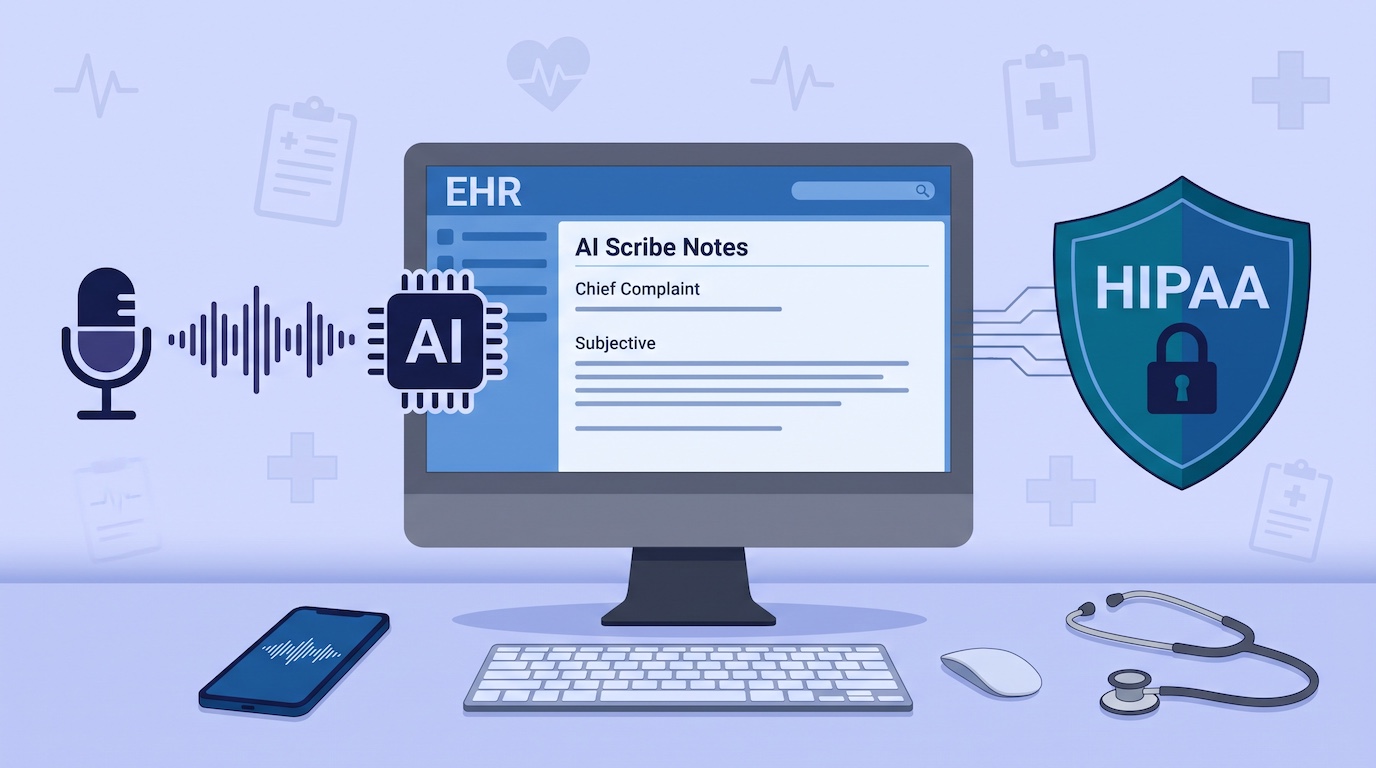
Are Clinical AI Scribes Safe?
What Clinicians Must Know About Data Privacy, HIPAA, and Patient Trust
AI scribes can give clinicians hours back each week, but only if patient data is protected. Learn the 9 HIPAA safeguards to demand from any AI scribe.
You became a clinician to care for people, not to type notes until midnight.
Yet most clinicians spend 10 to 15 hours a week on documentation. That means evenings and weekends spent charting, whether you're a medical doctor, therapist, nurse or allied health professional. AI scribes promise a way out. But if you handle patient information, the first question is the right one: Is it safe?
Here's an honest answer.
Patient Data Deserves the Highest Care
Diagnoses, medications, family history, therapy disclosures. This is Protected Health Information (PHI), and your HIPAA obligations don't pause because a tool is convenient. Any technology that touches PHI must meet the same standard you do.
Hesitating about AI isn't resistance to progress. It's good clinical judgment.
What AI Does Well
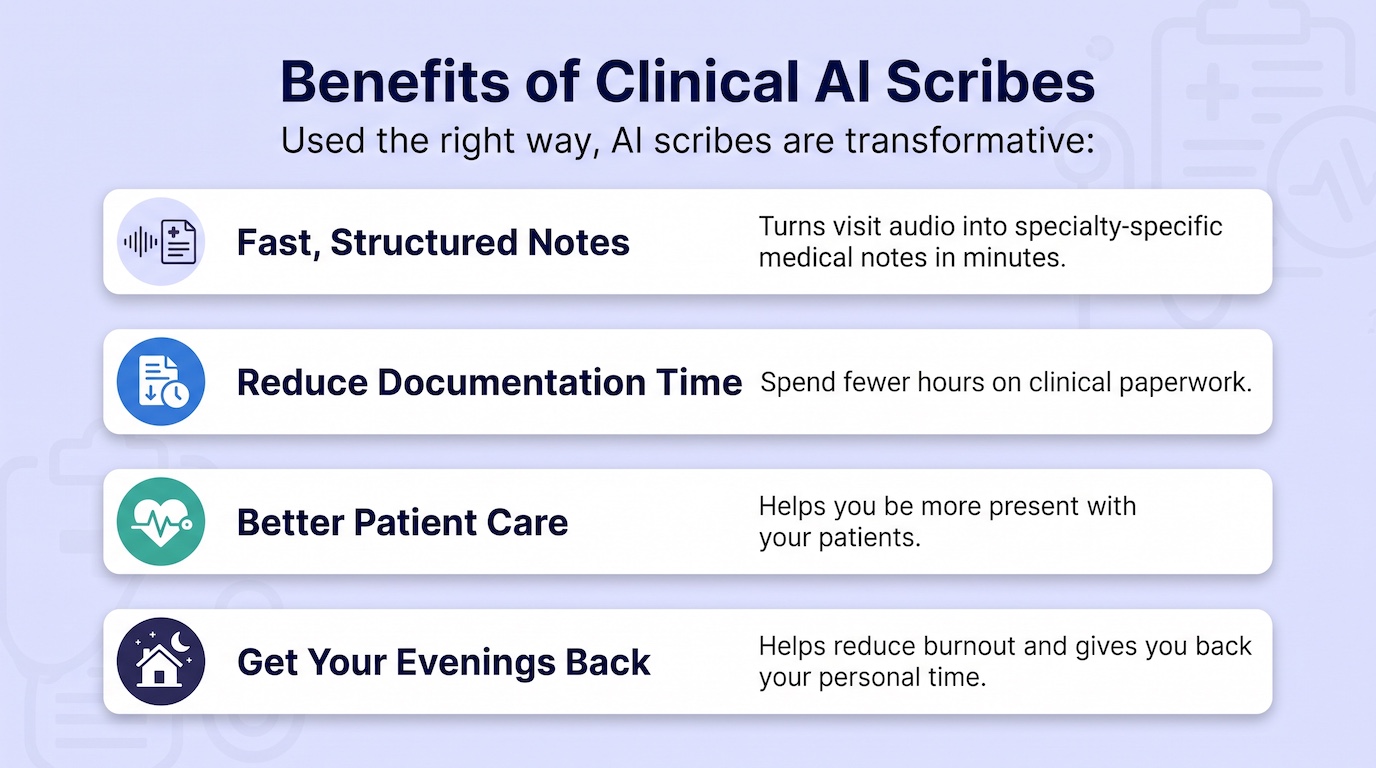
Used the right way, AI scribes are transformative:
- Turn visit audio into structured notes in minutes, in your specialty's format
- Reduce documentation time
- Keep you present with the patient instead of the keyboard
- Reduce burnout and give you your evenings back
The technology isn't the risk. How it's deployed is.
The Real Issue Isn't "Free." It's the Contract.
Many clinicians assume the danger is using a free chatbot, and that a paid plan fixes it. It doesn't.
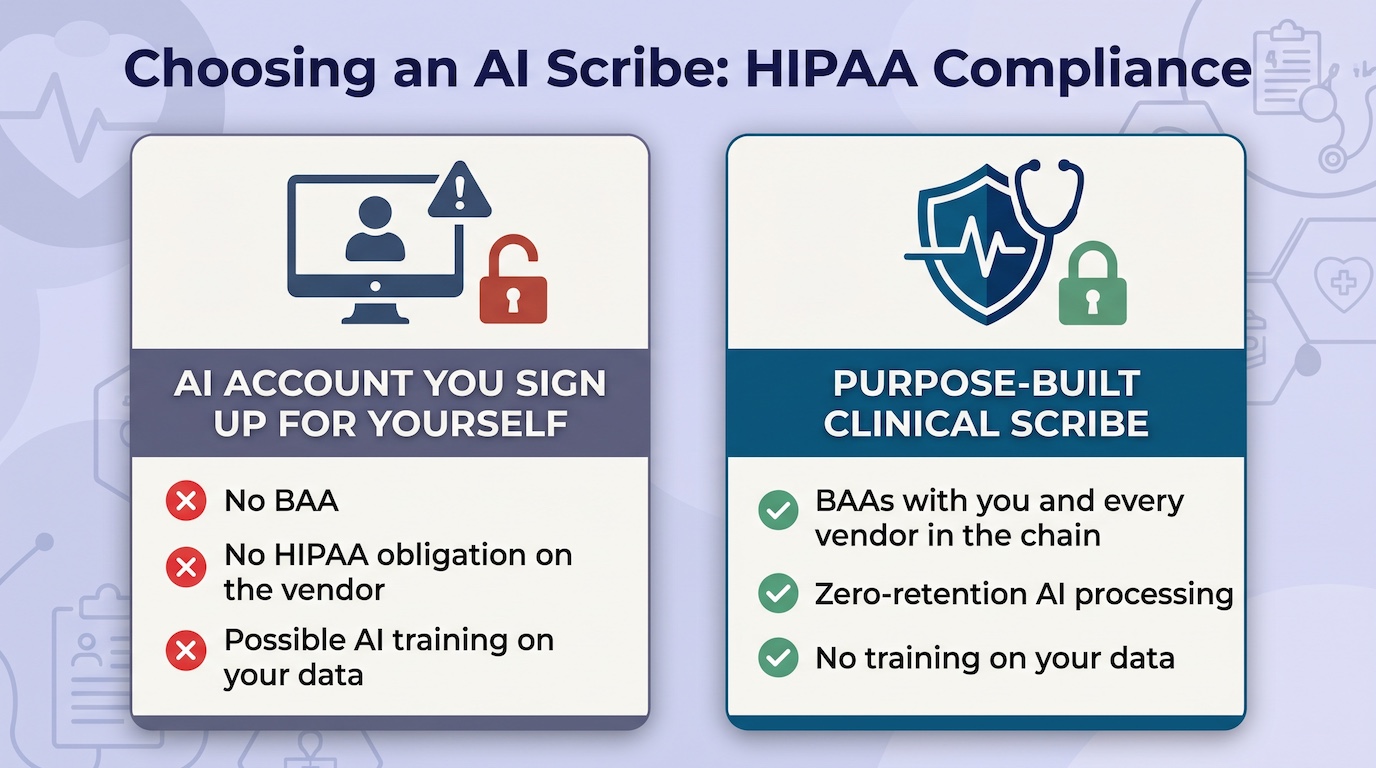
The problem applies to ChatGPT, Gemini, Claude, and similar tools alike, free or paid, when you sign up as an individual. The service sold to individuals typically:
- Comes with no Business Associate Agreement (BAA). HIPAA requires a BAA before any vendor handles PHI on your behalf. Consumer plans, even paid ones, generally don't offer one, so those providers have no contractual duty to treat your patient data under HIPAA rules.
- May use your conversations to improve models , depending on the provider, plan, and settings.
- Gives you no control over retention, access, or deletion.
Here's the nuance: these same AI companies do sign BAAs, but with businesses, through enterprise or API agreements with specific configurations, such as zero data retention. That's how a properly built clinical app can use their technology compliantly: the app signs the BAA, locks down the settings, and handles your data under HIPAA rules from end to end.
Same AI. Completely different legal and technical protection.
"But They De-Identify the Data"
Some AI scribe companies train models on clinician-patient data and say it's fine because it's run through automated anonymization. That's a recognized pathway, but it carries risk:
- Automated de-identification isn't perfect. One missed name, date, or location is a privacy failure.
- Context can re-identify. Even with no obvious identifiers, the contextual information can potentially point back to one person.
Once data is baked into a model, you can't pull it back out. The safest policy is the simplest: your patient data is never used to train AI models.
9 Safeguards Every HIPAA-Ready AI Scribe Needs
Use this checklist for any AI scribe you evaluate.
Every cloud, processor, and AI vendor that touches PHI should be bound by one.
Look for a written commitment, plus zero-retention AI processing.
AES-256 at rest and TLS 1.2+ in transit.
Audio should be deleted once the note is finished, and you should control how long notes and transcripts are kept.
Multi-factor authentication and phishing-resistant passkeys, not just a password.
Tamper-resistant records of who accessed what, when, and why, so any compliance review or incident investigation has a clear trail.
Only you should see patient-level data. Vendor staff should be technically blocked from it.
Reputable cloud hosting with continuous monitoring, vulnerability scanning, penetration testing, and disaster recovery.
The vendor should provide a ready-to-use consent template, to help you tell patients about AI documentation.
Questions to Ask Any Vendor
- Will you provide a BAA to me, and do you have one with every subprocessor?
- Is any of my data used to train AI models, by you or anyone downstream?
- How long are audio and transcripts stored, and who can delete them?
- Can your employees view my patients' notes?
- Do you provide a patient consent template?
If the answers are vague, keep looking.
Don't Forget Patient Consent
Whatever tool you use, tell your patients. Explain that an AI scribe assists with documentation, how their data is protected, and get their agreement. Recording consent laws also vary by state, so check yours. Transparency builds trust, and trust is the foundation of care.
A Scribe Built for This Standard
This is the standard BellaVita AI was built to meet. It's a clinical AI scribe for medical doctors, mental health professionals, nurses, allied health professionals, and other healthcare providers, in any specialty. It's designed around the safeguards above:
- A BAA for every clinician, plus agreements with all data processors and infrastructure partners
- Your data is never used to train AI models, backed by zero-retention AI processing
- Audio is deleted as soon as your notes are finalized
- AES-256 encryption at rest, TLS 1.2+ in transit, hosted on secure US-based AWS infrastructure
- MFA and passkey authentication, with immutable, cryptographically signed audit trails
- Zero-trust, least-privilege access. Only you can view your patients' clinical data.
- A patient consent template you can add to your own consent forms.
BellaVita AI drafts your clinical paperwork so you spend minutes reviewing instead of hours writing: progress notes, intake and evaluation reports, and treatment plans, with ICD-10, CPT, and DSM-5-TR code suggestions. Use built-in specialty templates or customize your own. You review, edit, and approve every document, then export it or send it to your web-based EHR in one click.
Don't take our word for it. Read the details and test it yourself:
(Currently available to US-based clinicians.)
The Bottom Line
AI can give you your time back, but only if patient privacy comes first. The question isn't whether a tool is free or paid, or which AI brand powers it. It's whether a BAA is in place, whether your data is kept out of model training, and whether you stay in control. Whether you choose BellaVita AI or another solution, hold every AI scribe to this standard.
Your patients trust you with their most private moments. Your tools should deserve that trust.